
Why have a positive blade angle?
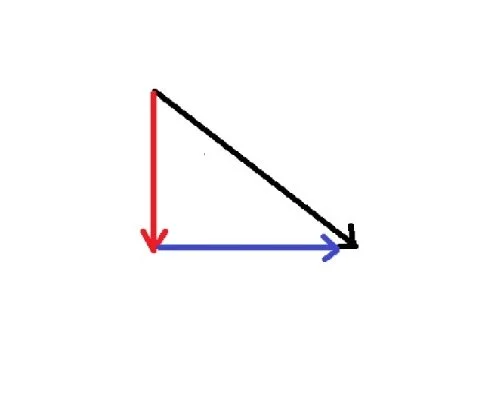
In this article, I will break down and explain why a positive blade angle matters
Every serious paddler, whether you run rivers in a kayak, cross lakes in a canoe, or race on a dragon boat, understands that pure strength only gets you so far. The true advantage lies in technique, and a critical element of that technique is the positive blade angle.
This seemingly minor adjustment in how your blade enters and travels through the water is crucial to a good stroke.
A negative blade angle results in spinning your wheels and lower speed.
A good positive blade angle helps to accelerate the boat.
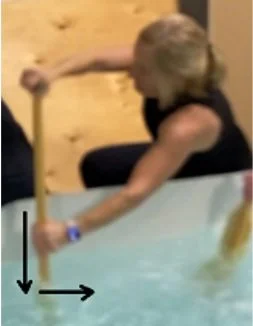
(In this picture, the paddler is part way through the stroke. She’s entered with a positive blade angle and is in the process of pulling back. I’ve selected a moment in time when the blade angle is neutral for clarity of explanation.)
The blade is moving down and to the right.
This is because the paddler is pressing down and pulling back.
Because of this, we can see that the force is also going down and to the right.
If we break this down, we can see a couple of things.
… Physics tells us that this force has 2 components. A magnitude and a direction (Nerd alert: this is called a vector). It is this combination that allows us to understand the dynamic at play here.
We can break this down into 2 elements, one vertical and one horizontal.
The first element is the red line, downwards, representing the downward press.
The second element is the blue line, going to the right, representing a pull to the right.
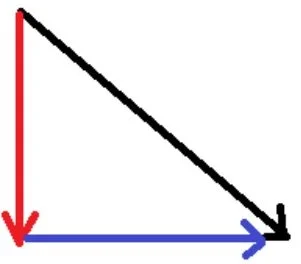
If we got fancy, we could use angles to compute the exact amount of each force and apply some trigonometry. Let’s not get fancy.
But wait! … Here’s the cool part.
Newton’s 3rd law of motion tells us that every force has an equal & opposite reaction.
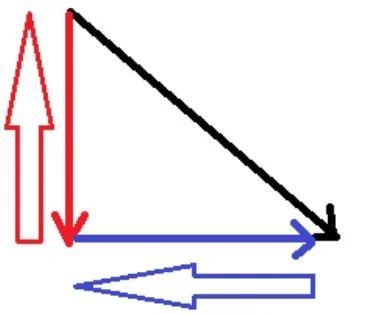
Simplifying the diagram a bit, this is what we have:
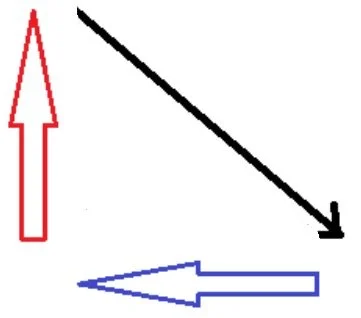
So here we have arrived at the answer, looking at the equal & opposite reaction
We get an upward force, ie. LIFT.
We also get a forward force, which means FORWARD THRUST..
This entire mechanism - the ability to “push the water down” to get lift, and “pull water back” to get forward thrust - is precisely why the paddle must enter the water with a positive blade angle.